
menu   Home Book Trailers The Goods Tools About Me  

Search This Blog

Showing posts with label accountable talk. Show all posts

Accountable Talk in the Elementary Classroom


For the longest time, I kept hearing all this buzz about ‘accountable talk’…but I was never quite sure what it was exactly. I knew that allowing my students to talk with each other about their ideas and the work they were doing was good teaching practice. Not to mention, talking is fundamental to their learning. But I also knew that not all talk promoted learning. So, what kind of talk is helpful to engage in for my student’s sustained learning? Accountable talk! Basically, in order for classroom talk to promote learning, it must be accountable.

What I’ve come to understand is that accountable talk is ultimately a classroom practice based on the student-centered discussion – where the students must support and defend their claims with evidence. Think about that for a minute…if you don’t understand what you’re talking about, you can’t really defend it using evidence. This is what makes accountable talk so helpful to learning and assessing. Talking with others about ideas and work is fundamental to learning. It gives us the opportunity to organize our thinking into coherent utterances, hear how our thinking sounds out loud, listen to how others respond, and, often, hear others add to or expand on our thinking. But not all talk sustains learning. For classroom talk to promote learning it must be accountable to the learning community, to accurate and appropriate knowledge, and to rigorous thinking.

Student-centered discussion using accountable talk is so beneficial to your student’s learning. For one, they remain highly engaged because they are allowed to use their natural desire to talk to one another. Having accountable conversation also allows students to process the lesson material much more deeply than teacher-centered talk. By actively discussing specific topics and defending their ideas and opinions on these topics, students internalize the material in a super authentic way. Plus, when you implement accountable talk, you’re easily able to evaluate and assess each student based on their participation in the discussion. Students can transfer the phrases and discussion strategies to non-academic talk.  Don’t be surprised to start hearing accountable talk stems out on the playground!

You can never be too prepared when it comes to teaching your class a new procedure or routine. No matter how well prepared we are, it always seems that a student will catch us off-guard with a question that we hadn’t expected. When you introduce accountable talk, you can bet that at least one student will ask, “Why do we have to do this?” or “What is the point of these talks?” By planning ahead, you can reduce stress and have answers ready for all of those curious questions. Aside from preparing for questions that students have, how will you logistically introduce the idea of accountable talk? With a video?  An activity?  A discussion? Whatever you decide, make sure you have a game plan. If your students see you getting flustered just by introducing accountable talks, you can bet that they too will feel flustered as they try to learn this new procedure.

When you feel that you personally are prepared and well-versed in accountable talks, it’s time to expose your students to this new idea that you will be implementing! While I love using videos to introduce new procedures or concepts, a class discussion is a great way to introduce accountable talks. After all, the whole basis for accountable talks is class discussion! Start by asking your kids if they know what accountable talk is?  Have a brainstorming session where all ideas and thoughts about accountable talk are welcome. You can even make a list as a class and then go back and review it once they understand what an accountable talk is! Explain that in a learning discussion, each contributor to the conversation is held accountable.  This means that each person must give reasons and evidence for their opinions.

This is the presentation I put together that walks through accountable talk and how it can be used in your classroom. It includes all sorts of videos, ideas, and explanations. Click the link for a handout packet that I've made with teachers that includes a synopsis and materials to get started right away.



Data Diner

Data in the classroom is like a diner- there are a lot of options for whatever you might need, it's a bit messy and can be quick. It is important to invite students into the data and make expectations clear. 

John Hattie, a researcher who does meta-analyses of other research, has determined that student-reported grades, teacher estimates of achievement, and clarity are some of the biggest influences on student achievement.  You can see the full list here. Any item above a .40 is considered to have positive effects on learning. 

To connect research to practice, we created a list of some options for collecting data and to increase student accountability. This by all means is not inclusive but can serve as a launching point. 

The menu is organized into three sections- small bites, entrees, and dessert.  


Small bites- are a great way to get a quick assessment of how students are doing at the moment. They don't need much prep and can be used with many materials. 

 This is an editable version of a pinch card- you can ask different types of questions and get quick responses. 

Entrees- these put meat on the bone. It takes more planning but can really drive student learning and accountability. 

Success criteria- to me, is the easiest and one of the most powerful ways to plan, assess, and provide feedback for students.  Teachers take a standard and then break down what needs to be done in order to achieve that standard.  Instead of a student saying "I don't get this," they can then state specifically what they don't get.  Creating success criteria allows teachers to play and assess based upon what the standards actually are asking and making their lessons more clear.  If you google "success criteria" there are many great examples online. 

An assessment grid is a quick and easy way to determine what students did and did not understand from an assessment. Using a strip of paper that corresponds with each question, teachers/students can correct and mark what is right (green) and wrong (red). Once finished, tape them on a piece of paper to easily see what students do and do not understand. It can also be done digitally in excel using "conditional formatting" for the columns.  Highlight the columns that are graded the same (1 correct, 0 no) and another highlight for the total at the end. 
A weekly word folder- provides student and parent accountability. Grade the previous week's work and send the folder home each week.  Parents review the work with students and return it back the next day.  Any unfinished work could be submitted as well.  This also helps teachers ensure that they return work in a timely matter.  

Another way to invite students in on the grading is to allow them to create checklists and rubrics. Students can use the document to self-check, peer review, and teacher feedback before the grading is done.  

Standards checklists allow teachers to keep track of what students have what standards. 

QR Codes of Google Forms can be a great tool for progress monitoring students with IEPS and anything else that needs to be documented.  Teachers can put different QR codes for students on one document, on a lanyard, or hanging on a wall to easily input information.


Another tool to increase student accountability is to have students respond to "Why I Got the Grade I Got" for an assessment or project.  This form helps to relate effort to outcomes.  On the backside, students could also add what else they know that wasn't on the test. 

Here are a few forms for student feedback- Glow and Grow, TAG feedback, and Stars and Stairs

Desserts- are the language and celebrations that occur in the classroom. It's more than a cherry on top to have students who can articulate what they agree and disagree with as well as are celebrated for their accomplishments.  

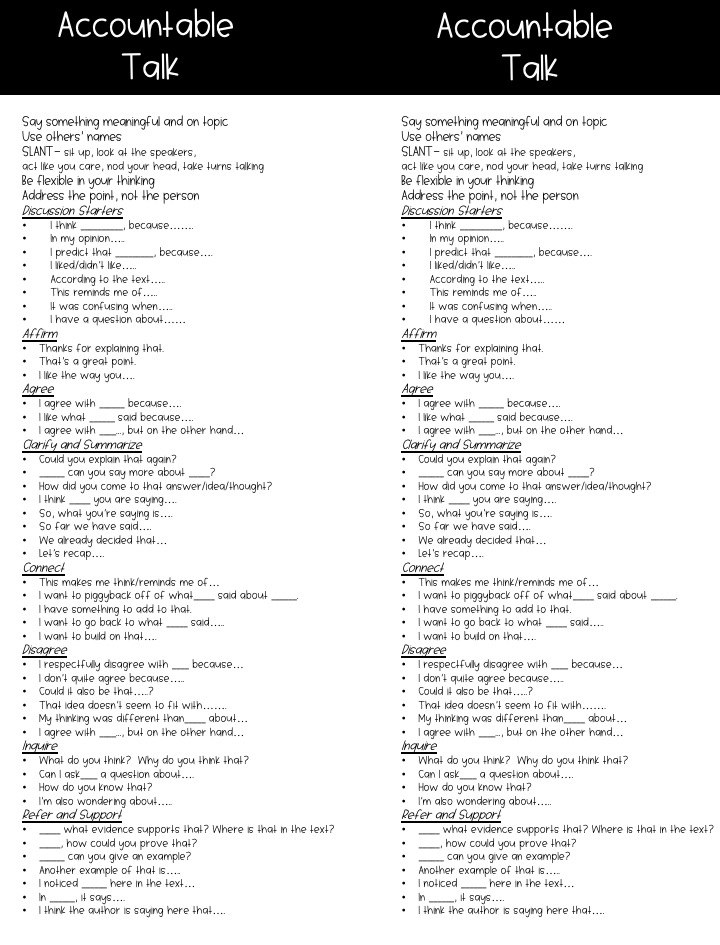
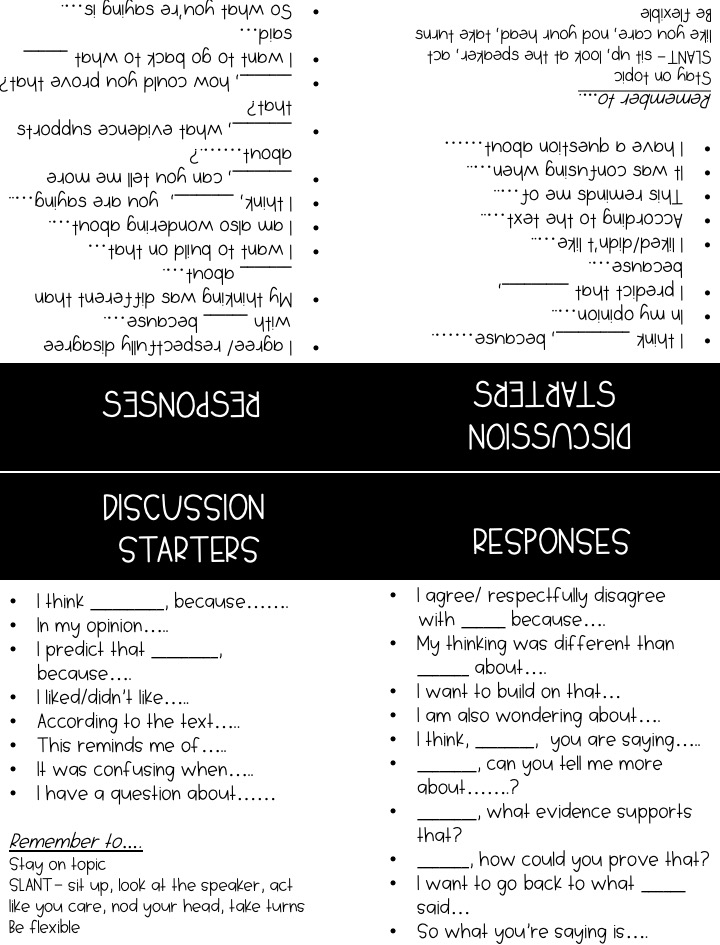
Accountable talk is the tool that moves classroom discussions forward and what our world needs more than ever.  Accountable talk is sentence stems that support dialogue and can be used in academic and non-academic settings. The attached PDF is great to laminate and have on tables, notebooks, or a location in the classroom.  Students also benefit from posters in the room with the stems.

Don't let your class get in out of alignment from not knowing what learning is occurring! There are so many awesome ways to let students know what they know and where they are headed.  Popping the unknown and making these practices central to a classroom can relieve stress and increase clarity and achievement!