menu   Home Book Trailers The Goods Tools About Me  

Search This Blog

Biography Reports

We've just completed our Biography Reports.  The kids chose famous Americans they would be interested in.

I pulled out some of my books and some from the library and we did a book pass where they sat in a circle and had about 30-60 seconds to look at each book.  This opened their curiosity to who else was out there and what they've done

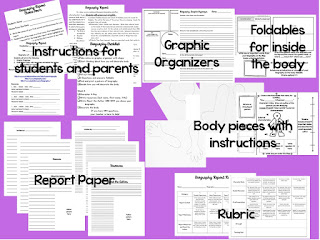
We researched in class and online filling out graphic organizers to gather information.  They wrote a report synthesizing their information and created a body that opened up to information inside.  I was so impressed with  all that they had created!!!!

.  

Get all of the materials by clicking here....

Tabletop Math

When introducing any mathematical concept without a doubt we are using manipulatives.  I like for the kids to explore the concept, make mistakes, and it always gives us a chance to ditch the worksheet/save a tree.  

For teaching addition and subtraction regrouping I get really fancy with Popsicle sticks and beans.  For area they use square tiles and a string for the perimeter and measure it with a ruler.  

For fractions we use pattern blocks.  Each piece gets a name.  The hexagon is our whole and then the kids have to figure out the names of the other pieces.  They make a key as they figure it out.  The triangle is no longer a triangle but 1/6th.  When we call them by those names they stop stressing about the math.  
They quickly start discovering "things equal the same thing Ms. Sarah" and just like that they are working with equivalent fractions.  I ask them to show me their thinking and they always blow me away with what they figure out when given freedom.  I might be green... but boy do they impress me!


For multiplication they roll a dice.  For arrays the first roll is the rows.  They place that many chips down.  The second is the columns and then they fill in the array.  They write the repeated addition and then multiplication problem.  Same goes when teaching sets in a group.  The first number is how many groups the second about is the stars or circles they draw in.

The fact that they get to write on their desk and it's at their own pace keeps them engaged and differentiated.  

I leave for Kenya in ONE MONTH!  It is surreal that we are on the countdown.  This week we are making round two of the chalkboards.  Home Depot donated ALL of the supplies!!! The Boy Scouts cut and sanded the boards and now all of the students are going to be painting them.  UNREAL!

Today I had the honor of depositing this money--- all collected from the hands of students.  You are looking at allowance, first communion money, door to door selling of lemonade.  I can't handle the hearts of kids.  They put everything into perspective.

This money is going to buy one world futbols.  

Join in with us at retouchtheworld.com


Who Would Win?

I am always trying to find ways to integrate multiple subjects into one project.  Last year I was introduced to the book series Who Would Win which lends easily to a student based project.  In each book the author chooses two animals to match up against and provides various facts about each.  He does it as a narrative with pictures but then also adds in interesting fact bubbles throughout the book.  Students can complete a checklist of who would win based on various comparisons--- height, fur, speed, etc.  At the end he puts them in a final match up and students are able to see if their predictions are correct.  They are engaged from the beginning!

As a class we decided we would create our very own who would win books.

#1 I started by reading a book to them.  We noticed various non-fiction text features the author uses throughout the book and listed them.  I then let the kids get into pairs and choose one of the other books to partner read.  I gave them a sticky note.. on one side they completed the checklist and on the other they wrote what new features they noticed.  We shared out and added the additions to our list.
#2 I introduced the kids to World Book online. Go to Kids---World of Animals. We talked about how it wouldn't make sense for me to compare a wasp to an elephant, so when choosing animals they would choose from similar species. In World Book they make it easy and have animal selections grouped by land mammals, water, reptiles, etc.  The kids get to select the two animals to compare and it creates an easy format that shows different facts about each.  The program has an easy print button that doesn't use up all of the ink. 
  
 #3 After students got their animals we came back and listed what we thought would be important to include in each book.  I wanted to give them a framework, but all them AMPLE space for creativity. I modeled some of the pieces for the book and how to do the comparisons with math.

Who Would Win Book Pieces
 1.  A cover--- which we modeled after Steve Jenkins layered artwork.  I made them the cover "Who Would Win" pieces and they did the rest.
2.  An introduction posing a question of what would happen if these two animals came across each other.
3.  THREE math comparing measurement using pictures AND words. (We were working on measurement in math so that's how I tied all of this in :))
4.  At least one page of other facts and a map
4.  Include interesting text features from the list--- tales of the tape, facts, etc.
5.  A final battle
6. Checklist of their comparisons

I set out all of the papers and pieces and honestly let them have at it! It took about 2 math blocks and 1 literacy to get it all done.  They were engaged THE ENTIRE time.  I roamed around and helped as needed... but it was all completely independent.  Clearly there were a few stragglers but for the majority that is all the time they needed.

I bound them with binding combs and then the kids had a book sharing party where they rotated around and read each other's books.  They were so amazed with what the other kids had done and just loved them.  I hung them in plastic zip lock bags outside in the hall as a display so that other kids/adults could read them.

Here are some snippets from their work


Here are the files I created for them to make their books.Happy comparing and creating!


I've added pages for to use World Book to compare Countries!  It's all part of my country report back.  Here's a freebie below


Makin Music

I don't live without my music in the classroom.  I rarely give instructions but let the music do the talking instead.  Here are my favorite hits to get us movin' or at times... relaxin'. I keep them all organized in playlists so that I can easily access it and that once it's done... no other random songs come on.  Have any others that I need to add?!?


Catapult Math

We have been working on engineering and simple machines in science.  I am of the mindset that if we are going to be doing something awesome/fun in one subject- we better try connecting it across the curriculum.

So here is how our Friday went---

First thing this morning kids made catapults using Popsicle sticks.  Check out THIS website for detailed instructions on how to make the catapult.  We tried different amounts of Popsicle sticks but found that having about 8 in the middle works best for getting distance.  :)

I arranged the desk in a large rectangle and I marked the space in one foot increments in the open space using green frog tape.  

After students made their catapults I had 4 students line up on opposite sides of our "field" (8 total). Each student had 3 trials to flip their pom poms the farthest.  Students filled out THIS RESPONSE sheet which includes numerous math operations and questioning- regrouping, measurement, comparing numbers.  

Here's the kids using the catapults! 

                                   
Students had to measure their distance and figure out how many inches it was total.


During literacy we read about the Vikings and watched how people use catapults today.

During science we watched some of the Punkin Chunkin' videos and decided to have our own in class using the pom poms :)  


We flung a few with our catapults... and then decided that using our simple machine levers... aka our arms might be a bit more fun.


Needless to say the kids loved it!  After it dried we voted on a motto-- which was pretty much unanimous and painted it on our art work. We were inspired by Oliver Jeffers as our mentor illustrator :)

My goal is to encourage the kids and make sure that they know.... it doesn't matter if they have flops... those flops leads to successes.  Success has flops-but you have to DO SOMETHING!  We use this motto all day and it helps relieve the anxiety of not doing something perfect... they just have to DO SOMETHING. This now proudly hangs in our classroom.  My question to you is what do you need to do?  What scares the bejesus out of you or makes you anxious that you need to try or move in that direction?  I have 3 big ones on my list that I am actively trying to DO SOMETHING in.... what are yours?!?


100th Day of School

We had a lot of fun today!  Minute to win it, activities, SNACKS... all of the good stuff.  I created this stuff for me to keep organized and for the kids to learn and hopefully have a good time.


Happy 100th day of school!!!!

(snack labels for godlfish_

The Matchbox Diary

The Matchbox Diary

A writer’s toughest task isn’t finding an idea but figuring out what to do with it


The Matchbox Diary written by Paul Fleishman is an an incredible book that can be used within the classroom as a launching point for narratives, immigration, definition of literacy, American history, industry, etc.  I used this book for a Summer writing camp and in a 2nd grade classroom.  I am sharing my lesson plan outline that I use while teaching. 


Materials:
·         Sharpened pencils
·         Mechanical Pencils
·         Clipboards
·         Paper
o   Lined
o   Handwriting
o   Final copy
o   Black cardstock- to mount art
o   White thick paper- for art
·         Post-it notes
·         Plastic Sleeves--- to be used for editing if don't don't want to use post-its
·         Dry erase markers-- "
·         Socks (to use as eraser)-- "
·         Sensory word list- From Jeff Anderson book
·         Chart Paper
·         Markers
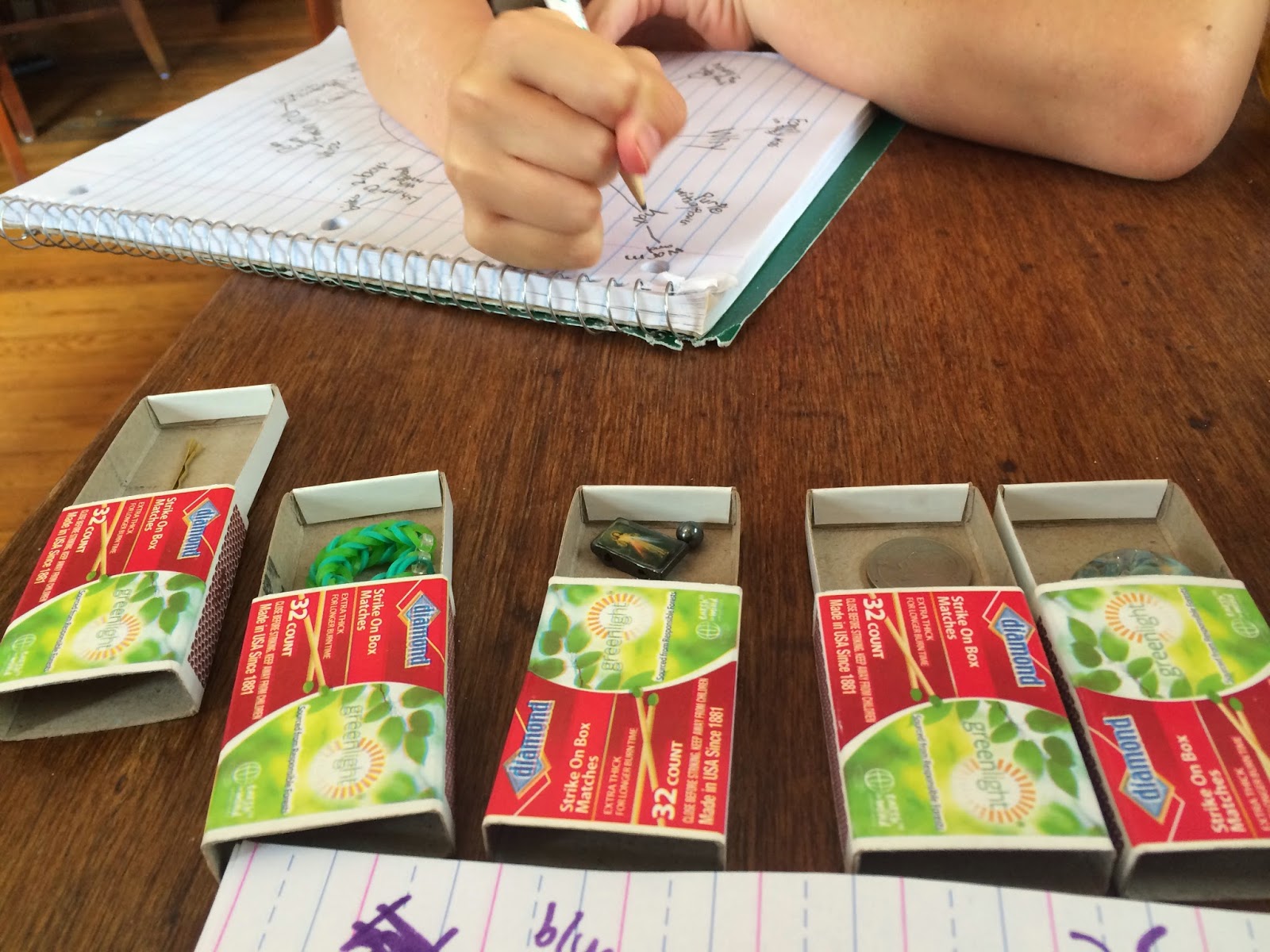
·         Cigar Box with items in matchboxes it that I can tell stories about  (i.e. seashells, bottlecap, key, dried flower, ticket stub, ring, marbles, (non-item like a paper clip)etc.)
·         Oil Pastels or watercolor
·         Painter’s Tape
·         Report covers

Before--- students bring in 5 items that have memories.  I sent this note as apart of their homework:

Special Assignment!  
We will begin writing narratives in class  for the next few weeks.  Writer’s write about what they know.  As a writer, please bring in 5 small items that trigger a memory or something important that has happened in your life.  Bring items such as a small seashell, concert ticket, bracelet, pin, medal, coin, etc.  All of these items should fit in the attached plastic bag.
Please bring your 5 items Monday.  


Day 1:  Brainstorm, First Draft

Bring in personal Cigar Box, set it and book on the table.

On a chart paper-- write LITERACY 

Ask class what it is to them.  discuss in groups-- ask the following questions as necessary.
Literacy—what does it mean?  What does it look like? How do you engage in literacy? Does being literate really only mean creating meaning from the symbols known as alphabetic letters and characters? What about reading symbols or visual images that are logos or are in advertisements? What about reading wordless picture books? Most of all, who gets to define what literacy is or isn't? 

The field of literacy has actually been pushing for quite some time against traditional definitions that are limited to reading and writing, but what do your students think? Create sticky notes on chart paper. Talk about responses and emphasize that literacy is to CONNECT through writing, stories, and pictures.  

Background Info---historic information about immigration, Ellis Island, America in the early 1920’s, or Italy, the great-grandfather’s country of origin.  Ask students what they know about Ellis Island, show a picture of the statue of liberty.  Talk briefly about what it means to be an immigrant.  Discuss some of the reasons people have for leaving their homeland, sometimes in the face of danger, to live in a new country. 

Ask who keeps a diary or a journal.  Why do they keep one?  What's in their journals?  Is it just words? What's the importance or value of a journal/diary?
  
Begin reading about half of the book, then paused to do a quick review—What object did the girl choose to have her great-grandfather tell her about? What was inside the cigar box? Why did great-grandfather keep his diary in matchboxes and not written in a book? What was in the first box she opened? What is the story of the olive pit?—before finishing the book.

Open my box, pass out boxes and let the kids open them.  Begin telling story of 1 or 2.  Then get to the paperclip
The object in box is my paperclip. I use paperclips all the time. They are really useful. I use this one to hold papers together.
Wait for reactions.  Clearly not a story.  So I ask  group what more they wanted to know—perhaps if they asked me some questions, I might find the paperclip’s story. Where did you get it? What makes it special? How long have you had it?

Reach for another box.  Begin telling the story.  What else do they want to know- what does my story need to feel complete? Being making a list of what a story must entail. 

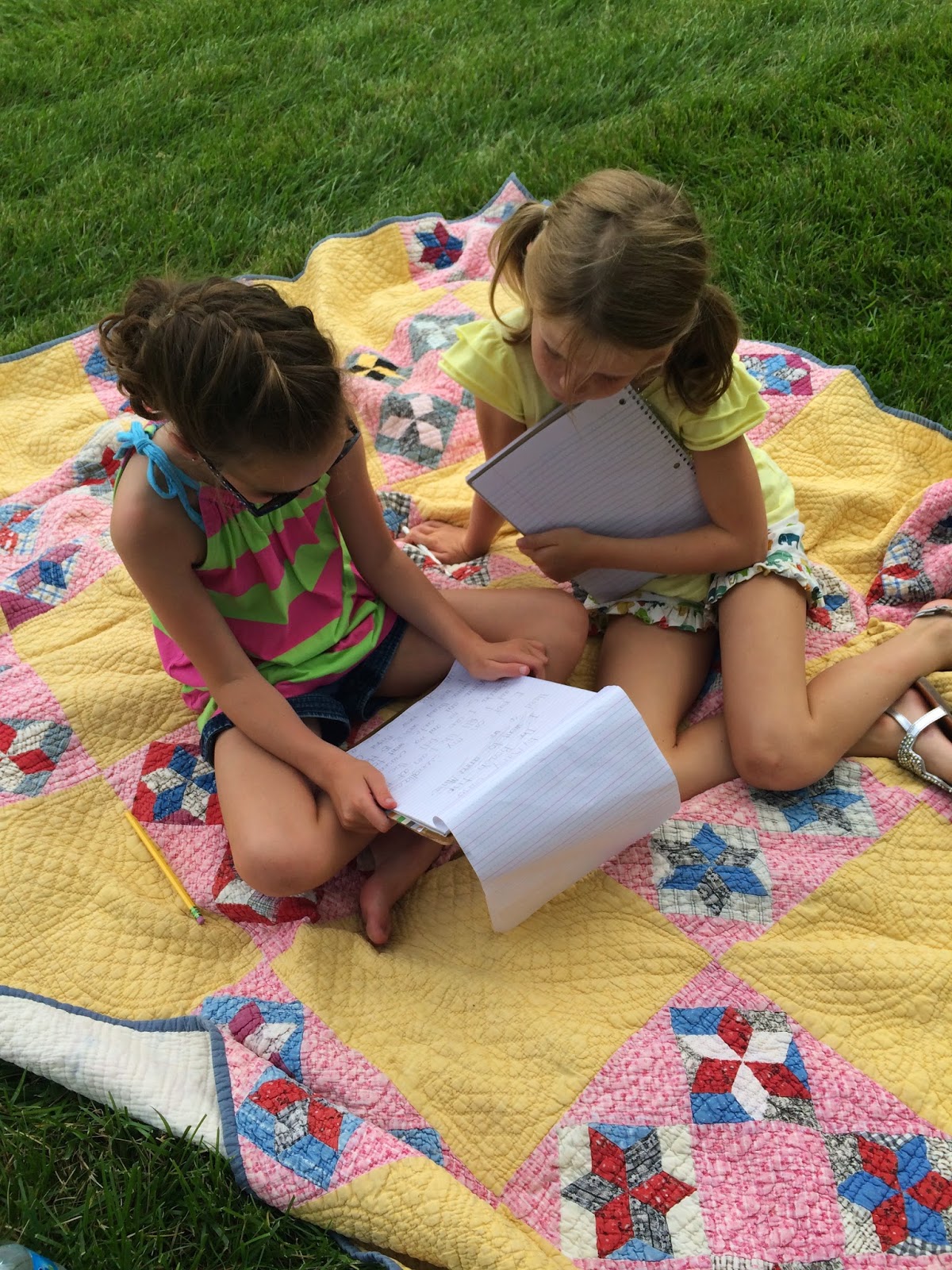
In groups of 2-4 have students share items in their boxes.  Ask them and their groups to decide which item has a story they want to tell the most.

Close by sharing what item they think they will share about and what memory it holds.  

Day 2: First Draft/Graphic Organizer 

Read Wilfred Gordon by Mem Fox

What brought about the memories?  Did they have to have words?  

Model writing your first draft with one of your items.  Talk aloud using a bubble map to retrieve all of the important details-- Where was I? Who was I with? What were we doing?  Why? What happened? How did I feel? 

Give students to brainstorm about their item in their writing notebooks.

Take a picture of them with their item in their hands.

Closing:  Share about how using the graphic organizer helped with their memory.  How did they sort it?  What helped organize their thoughts or get the most detail?

              
Day 3: First Draft Writing

Read Art & Max
--- What happened to the characters? -- emphasize that you can change the form, add details, mix things up, and still have your original idea.  Sometimes starting again or looking things from a different perspective creates something better.  

Share with them my story
The Moose Story
                  i was walkin.  I was walking by myself.  It was late at nite.  I had to go to the bathroom. I got on my bik.  It was foggy. I saw a baby moose.  I heard a loud noise behind me.  A moose was running to me.  I was scared.  I looked for help.  i kept riding.  I went through the forest.  I fell.  I stayed there until she left.  I rode back fast!

Write suggestions on chart paper.  This becomes our checklist of features to include in our writing.
Details, sentence variety, figurative language, capital letters, punctuation, opening sentence, closing sentence, spelling, voice/point of view, transition words, adjectives

Review dialogue marks.  Pass out sensory words sheet for descriptive words. (can find online if don't have Jeff Anderson book)  

Model writing my own story with an item from my box in front of them.  Think out loud and look to my graphic organizer for details.  

Give students time to write their story.  Share with a friend what they have written so far.  


Day 4:  Finish First Draft/Revisions
Read Chester    Emphasize that the writer has the power!  Whoever has the pen decides what happens.  There's power in what they write.  When we share writing we want it to be whole and complete and that sometimes another set of eyes can help strengthen us. Re-read the moose story from the day before--- ask them to give me a strength--- something I did well.  Then, a teaching point--- something to work on.  Show them how to write this on a sticky note-- star for strength, circle for teaching point.  

Give students time to finish first drafts.  When they are ready meet with a friend and on a sticky note write strength and teaching points.  Students can also put their writing in clear plastic sheet protectors to give additional specific editing marks.  I like using the sheet protectors so that it doesn't mess up the authors writing or distract-- or on the off chance the edits aren't right.  :)  

Revise on that paper or start a 2nd draft.
                                       
Day 5:  Revisions and Editing

Read "Little Red Riding" ---finish reading/editing with 2 friends.  

As students finish their revision they meet with teacher to conference and revise.   Pass out final draft paper as they finish with drafts.  Give mechanical pencils.  

Day 6: Finish final drafts and create art piece to go with it.
Read The Secret Box


Teacher models sketch and art of item or memory.

Sketch out ideas of item on post it- or small piece of paper.  Approve with me and then give oil pastels or watercolors and small squares to draw. Put in report covers, bind, etc.


In my 2nd Grade Class I had them paint with watercolor and I introduced strategies for using the paint.  They were really easy and turned out amazing.  We matted them on place pieces of paper and hung them in the hall above their writing.  


Share and celebrate!!!